News - Unlocking the Secrets of Stardust: Tiny Grains from Giant Stars
Business Strategy
Unlocking the Secrets of Stardust: Tiny Grains from Giant Stars
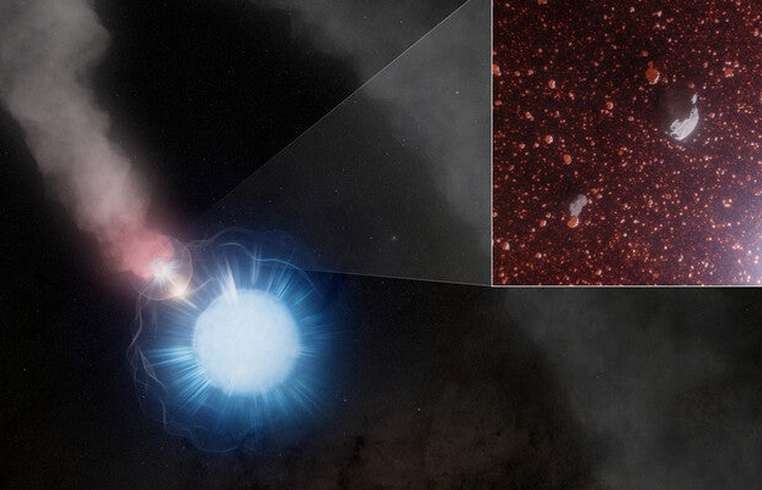
In a groundbreaking exploration, scientists have employed the James Webb Space Telescope (JWST) and the Atacama Large Millimeter/submillimeter Array (ALMA) to decode the mysteries of stardust emanating from WR 112, a massive binary star system. The JWST's mid-infrared images had initially showcased dazzling spiral arcs of dust, while ALMA's advanced capabilities missed any signs of dust, suggesting the grains were small enough to evade detection. Researchers deduced that most dust grains in WR 112's spiral structures are under one micrometer, with a significant portion merely nanometers wide. 'It's astonishing to discover that some of the universe's largest stars are the origin of its smallest particles,' remarked Wu, a participant in the summer research program at the California Institute of Technology. 'The sheer size disparity between these stars and the dust they create is akin to a quintillion-to-one ratio.' The project's international team identified dual sizes in the stardust: nanometer-sized grains and a set approximately 0.1 micrometer across, resolving longstanding inconsistencies in historical data of similar systems, which alternated between tiny and larger grains. The study further probed into the physical mechanisms likely responsible for fragmenting or evaporating dust grains in proximity to the intense radiation fields of such stars, which appear to obliterate intermediate-sized grains under specific conditions. Given that WR 112 ranks as a top cosmic dust producer—annually yielding quantities equivalent to three Earth moons—these newfound insights into grain size hold exhaustive implications for understanding how massive binary systems like WR 112 contribute carbon dust and feed the wider galaxy. Supported by mentor Yinuo Han, Wu, alongside a team from the U.S., U.K., Japan, Netherlands, Australia, and Germany, enriches our grasp of stardust and its cosmic narrative.
About usyoo

Categories
Tags