
News - In Jermuk they plan to build a new airport by 2028. It is a project that has been discussed for about 20 years.
Business Strategy
In Jermuk they plan to build a new airport by 2028. It is a project that has been discussed for about 20 years.
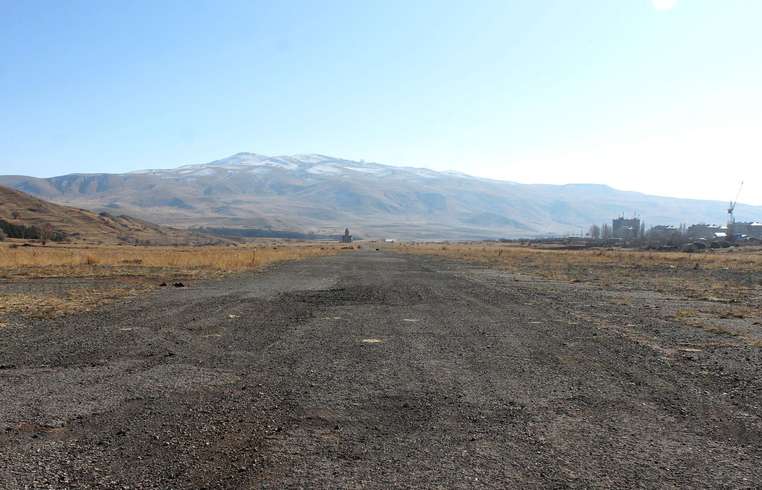
From October this year, Vahagn Arsenyan has been serving as the governor of Vayots Dzor, and prior to that, from 2021 to 2025, he was the mayor of Jermuk. In an interview with Forbes, he spoke about the prospects for the community’s development and, in particular, emphasized the role of the airport: “The upcoming airport will create new opportunities in logistics and agriculture… We are preparing to build a small airport, which will initially serve domestic flights, and later be expanded to international routes,” Arsenyan told Forbes. “Ten years from now I see Jermuk as a world-class resort city with an international airport, more than ten modern spa centers, and a developed ecotourism sector.” The topic of a new airport for Jermuk has been discussed for about twenty years, but it has never progressed beyond the paperwork. The old airport buildings in Jermuk are privately owned. There has been an airport in Jermuk since the second half of the 1950s. It lies near the Yerevan–Jermuk road on the left bank of the Arpa River. During the Soviet years, flights to this resort town were operated by various types of aircraft and helicopters. Moreover, this is Armenia’s highest airport (situated at 2070 meters above sea level). Armenia’s highest and unusual airport Since the 1990s there have been no flights at Jermuk airport. After independence, the airport was on the balance sheet of the state-owned enterprise Erebuni Territorial Airports; however, in 1999 the government under Vazgen Sargsyan decided to detach the airport’s property from the enterprise and hand it over to the Jermuk community by ownership free of charge. The latter then sold the airport buildings in 2002 to Melsik Arakelian, the former head of the airport. The two-story building of the airport, which includes the former passenger terminal, control point, ticket office, and staff rooms, is now considered a private house and belongs to M. Arakelian. He also acquired a 1.5-hectare plot adjacent to the building. The remaining airport land (51.6 hectares, according to a government decision) remains state property. New airport project and the search for a site In September 2008, the government under Tigran Sargsyan declared Jermuk a tourist center. The decision stated that by 2012 Jermuk should become a four-season tourist center, develop as a health resort and winter tourism center, a center for hosting international chess tournaments, a nationwide and international youth and student camp site, and a cultural tourism center. The government planned that Jermuk would attract 100,000 visitors annually, tourism revenue would reach $100 million per year, and 4,000 additional jobs would be created. To realize these ambitious development goals, several measures were outlined, one of which was to have an airport for helicopters and light aircraft and to organize the corresponding routes. Before this decision, in July 2008, the government had defined the year’s priority tasks, including adopting a concept for the development of small aviation. Building on this, the Civil Aviation Agency (CAA, now the Aviation Committee) later developed a relevant concept. It stated that the revival possibilities of several of our airports, including Jermuk, had been studied. The CAA viewed the development of small aviation in Jermuk from a tourism perspective, which was logical and in line with the above government decision: given Armenia’s government program aimed at developing Jermuk, it was evident that a modern recreation and health center must be equipped with the proper infrastructure. Taking into account the region’s relief and the former Jermuk airport’s operation experience (the airport was considered a difficult airfield in terms of flight operations), for the purpose of developing air communication in Jermuk, in designated areas it would be possible to build both a new airport and a new helicopter pad. Thus, in 2008 the issue of a new airport in Jermuk was being discussed at the government level. On the basis of the decision to declare Jermuk a tourist center in 2008, in 2009 the government adopted the Jermuk Development Strategy for 2009–2012. V. Ayvazyan told Hetq that the strategy was developed by the Swiss company TigerDev Swiss. The strategy stated that it was a company specializing in designing and managing winter resort projects (which was later dissolved). The document contains a historical overview noting that Jermuk once had the possibility to receive small aircraft at a southern part of the city’s airport, whose building and runway had not functioned for many years (as noted since the 1990s). Citing the CAC, it was indicated that the runway was no longer suitable for small aircraft, landing near the airport was unsafe, and a church built at the runway’s end also posed an obstacle to airport operation (notably, the Saint Gayane Church, funded in 2007 by Vahagn Arsenyan’s father, Ashot Arsenyan, founder of the Jermuk Group, a former mayor of Jermuk, and a former member of parliament and businessman). According to the strategy, five options for a new airport and helicopter pad near Jermuk were considered. Notably, both the new aerodrome and helicopter pad were contemplated, and two options were located about 15–20 kilometers from Jermuk in a straight line. The first option was in the area east of the Kechut reservoir at roughly 2070 meters above sea level. In the Vayots Dzor regional land-use plan this option is described as follows: the area is located about 6 kilometers from the center of Jermuk (the distance is by road, not straight line), surrounded by mountain slopes on three sides, which provides wind protection, while the area toward the Arpa River valley is open. It notes that meteorological studies would be required in the planning phases. Its suitability is reinforced by its proximity to a proposed railway station near Jermuk (as is known, the railway has not been built), which would allow equal use of two transport modes and enable an efficient and time-saving organization of the necessary multi-type air transport (passengers, freight, tourism, business, personal, and collective), as well as support for agricultural, disaster relief, aerial patrols, research, mapping and other works, including possible aerial taxi services and private aircraft operations. As a result, this would involve the dynamic integration of the regions and economic development. It is also proposed to build a road that would serve both the railway and the helicopter pad. The area’s natural, relatively mild slopes would allow certain works (after additional meteorological studies) to build a runway of about 2000 meters for servicing light aviation aircraft. The site would also provide a sanitary-protective zone for neighboring settlements, located about 1 kilometer from the nearby Kechut village. The site’s service and aviation conditions would be similar to those of the old Jermuk airport. The second option is a mountain plateau north of Jermuk, which, as noted, was considered in the Soviet era. The plan states that the proposed area, at an altitude of 2240 meters, has a minor restriction: it is about 170 meters higher than the first option, which complicates its operation (additional meteorological studies required). The aviation conditions are similar to the first option. The third option is 20 kilometers from the city center, on the left bank of the Korotan River in a widened valley at 2280 meters; the runway length would be 2.5 kilometers. The area’s relative remoteness from the city was offset by the fact that it lies at equal distance from the Vayots Dzor and Syunik regions, which would help develop underutilized areas of Syunik and recreational development near the Spandaryan Reservoir (approximately). The fourth option is in the eastern part of Gorayk town in Syunik at 2150 meters, with a runway length of 2 kilometers and a road distance of 29 kilometers from the city center of Jermuk. The fifth option is in the northwest area of Karmrashen village in Vayots Dzor, in the valley of the Herher River, at an altitude of 2050 meters, with a road distance of 25 kilometers from the city. The plan notes that the winter operation of the 2510-meter pass is a limiting factor; another variant involves tunneling at 2200 meters with a length of 3.3 kilometers, with an estimated cost of at least 50 million U.S. dollars. The choice: helicopter pad Ultimately, the Vayots Dzor territorial plan emphasized not an aerodrome, but a helicopter pad. In collaboration with the CAC, taking into account the above variants and the results of expert studies, the project deemed it advisable to develop the second variant (the area adjacent to Jermuk’s city facilities) as a helicopter pad, while considering the Gorayk, Sisian, and Kapan airports as regional airports that could be used for the operation of lower-class airplanes and helicopters. Thus, the helicopter pad in the northern part of Jermuk’s plateau was considered, while for the aerodrome an option near Goris, Sisian, or Kapan was proposed. In Jermuk’s 2009–2012 development strategy, which also mentioned three variants, the preference was given to building a helicopter pad near the city, emphasizing that this is financially more feasible first. It also stated that before investing in either an aerodrome or a helicopter pad one must assess the cost, whether there is private sector interest, or whether there is demand for flights to Jermuk relative to other transport modes. “Given that the number of helicopters arriving in Jermuk will undoubtedly be small, their impact and the nuisance caused by noise will be limited. Therefore the choice of a helicopter landing pad in Jermuk is not particularly difficult. It should not be located near specially protected natural areas or residential zones. It is anticipated that helicopter-visiting guests will mostly be affluent customers of the resorts, so the landing pad should be located as close as possible to the resorts. In this regard, for the coming years it is proposed to consider only the construction of a helicopter pad, which would not require large financial investments. The 2008 preliminary studies by the Swiss TigerDev Swiss company suggested a location for a helicopter pad that would prevent or minimize helicopter flights over the city,” the strategy noted. As mentioned, the government approved this strategy in 2009, and the Vayots Dzor territorial plan including Jermuk’s new airport site was approved in February 2010. Yet even in spring 2009 it became clear that the government was not considering building a new aerodrome in Jermuk. The reason is that then- deputy minister of urban development and chief architect, Narek Sargsyan, a Jermuk native who was responsible for developing Jermuk as a tourism center, stated in April 2009 that a new airport in Jermuk could not serve properly because the city is a cul-de-sac, outside the main air corridor. He noted that, given Armenia’s plans to develop as a transit country connecting the north and south, Goris airport could become an alternative to Zvartnots and Shirak airports, considering its distance and connections with both the Nagorno-Karabakh region and Armenia’s southern regions; however, that plan did not materialize. The helicopter pad project in Jermuk remained on paper. The topic of developing small aviation in Jermuk resurfaced during Karen Karapetyan’s government (2016–2018), but no progress followed. New airport on the old site And now, in fact, the former town mayor and the current governor of Vayots Dzor are once again announcing the city’s new airport. When asked by Hetq whether there is a concrete program, Arsenyan referred to the government’s 2008 decision to declare Jermuk a tourist center and to the 2009–2012 development strategy. According to the official, the Swiss TigerDev Swiss strategy has since been periodically revised by the Jermuk municipality in light of new circumstances. The former mayor and the current governor also conveyed that, as a result of discussions, the airport would be built on the site of the old facility. The question arises as to how flight safety will be ensured, given that the Saint Gayane Church, built by Arsenyan’s father and located just 350 meters from the southern end of the runway, has effectively become an artificial obstacle to large and small aircraft flights, a concern raised by experts. Nevertheless, when exactly the new airport will be built and with whose funds remains to be seen. We asked whether the Arsenyan family or the Jermuk Group would participate in the project. Vahagn Arsenyan’s response is as follows: there is a visible increase in the community’s own revenues, which makes the realization of the new airport feasible. The project is planned to be implemented in 2026–2028 within a subsidized state–community–private partnership framework. The Jermuk Group company plans to undertake all asphalt works at its own expense during the airport’s construction. Regarding the government’s involvement and its participation, the governor noted that every project in the region is always in the government’s focus, including this one. After finalizing the plan and presenting it as a subsidized program, it will be submitted for subsidies from the state budget within the prescribed timelines to the Vayots Dzor Governor’s Office, and then to the government for discussion and approval. First photograph: the sloped runway, Saint Gayane Church, Amulsar and Jermuk’s Left Bank neighborhood; airport photographs from 2019.
About usyoo

Categories
Tags