News - Superstar S301: Racing Around the Galaxy's Heart
Business Strategy
Superstar S301: Racing Around the Galaxy's Heart
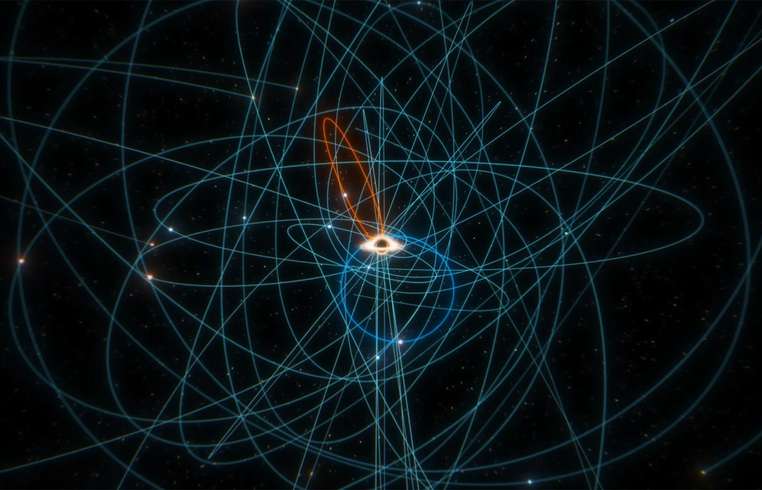
In an astonishing discovery, researchers at the Max Planck Institute for Extraterrestrial Physics have identified a lightning-fast star, S301, making dizzying orbits around Sagittarius A*, the Milky Way’s supermassive black hole. Living in what astronomers consider to be our cosmic neighborhood, S301 has earned the title of the fastest-known star, reaching mind-boggling speeds of 15,500 miles per second. The speed achieved by S301, recorded at the peak of its orbit, stands unparalleled. To truly comprehend this velocity, consider that the previous speed champion among celestial bodies, a star with a super Neptune companion, managed just around 1.2 million mph, not even scratching the 15,500 mps realm of S301. Even the Parker Solar Probe, humanity's swiftest craft, cruises at only 430,000 mph, nowhere near the staggering speed of S301. S301’s journey takes it dangerously close to Sagittarius A*, orbiting 10 times closer than its nearest stellar kin, S2. This proximity means it experiences the gargantuan gravitational forces of the black hole with unmatched intensity, providing researchers with an extraordinary laboratory for studying these enigmatic cosmic objects. Understanding black holes presents a formidable challenge given their nature as celestial voids that trap all, including light. Instead, astronomers rely on observing the influence of black holes on their surroundings. The study of S301 could unlock vital insights into these effects, such as the intriguing Lense-Thirring effect—predicted in Einstein’s theory of general relativity—which describes how rotating massive bodies can warp spacetime. Felix Mang, a Ph.D. student and key researcher at the Max Planck Institute, emphasized S301's critical role, stating, “S301 is the first star to orbit directly in the region around Sagittarius A* where the frame-dragging effect is extreme. We’re not just measuring spacetime curvature; we are measuring how it gets distorted by the rotation of the black hole itself.” Despite its importance, S301's low luminosity poses its own puzzle, being two billion times dimmer than the prominent Betelgeuse, rendering it nearly invisible and exceptionally challenging to study. To counteract this, the team utilized cutting-edge equipment like the Gravity and Micado instruments on European Southern Observatory’s high-powered telescopes stationed in Chile to identify and track this elusive star. As researchers prepare to observe S301 over the coming years, they anticipate that this star could illuminate many dark aspects of black holes. Through precise measurements and extensive analysis, S301 stands to redefine our understanding of how massive black holes shape our universe, holding the potential to confirm or challenge existing theories rooted in the foundational physics proposed by Einstein.
About usyoo

Categories
Tags